By Denise Brehm | Department of Urban Studies and Planning
Google.org announced on Sept. 15 that the MIT Transit Lab is a recipient of $2.1 million in funding — one of only 15 projects selected in the worldwide Google.org Impact Challenge: AI for Government Innovation. The funding from Google’s philanthropic arm will support NGOs, social enterprises, and academic institutions as they integrate artificial intelligence-powered solutions across topics like health, resilience, and economy.
The Transit Lab’s winning project, the Public Transit Intelligence Hub (PTIQ), aims to unify public transportation agencies’ real-time monitoring, operations control, and passenger communication systems into a single centralized AI-orchestrated platform that will allow transit control center staff to make better-informed, on-the-spot decisions, and provide riders with more immediate and accurate information.
The control centers of public transportation agencies are similar in appearance to the portrayal of NASA mission control in movies: rooms filled with employees monitoring dozens of radio feeds and computer screens relaying real-time camera data about stations and their operations, transit vehicle locations, riders, traffic, and road conditions. Unfortunately, the information coming in is fragmented, rather than integrated into a centralized system with overall awareness of the network’s conditions. This system creates an intense work environment for the transit staff making operations and communications decisions that can affect thousands of passengers relying on transit to get them where they need to go.
“Public transportation agencies are required to make decisions around the clock regarding real-time operations, control, and passenger communication,” says Awad Abdelhalim, associate director of the Transit Lab, and PTIQ co-principal investigator, project director, and technical lead. “Our goal isn't to automate those decisions, but to make sure the people making them have the best information possible. By unifying and streamlining data and information flow from fragmented and siloed internal systems, PTIQ will improve the experience of both riders and the transit workforce.”
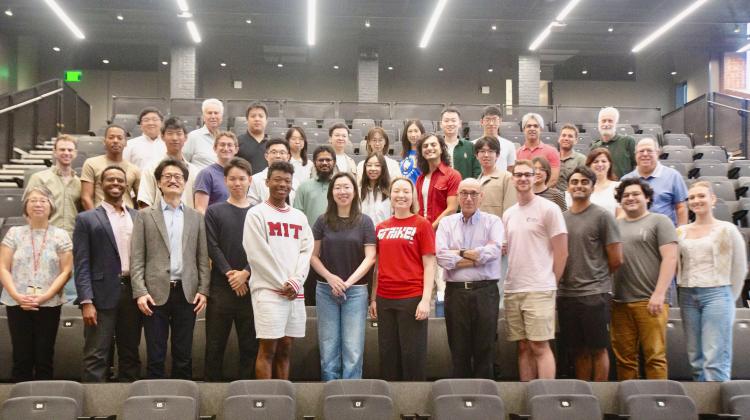
Jinhua Zhao, the MIT Class of 1941 Professor of City and Transportation, head of the MIT Department of Urban Studies and Planning, and founder and director of the MIT Mobility Initiative (MMI), is the other co-principal investigator on the project. The PTIQ program manager is MIT Lecturer Jim Aloisi, who directs the Transit Research Consortium, which will also work on the project. That consortium is comprised of researchers from the Transit Lab, MMI, and Northeastern University, where Professor Haris Koutsopoulos takes the lead.
Read the full story on MIT News.