







DUSP faculty receive promotions (Fall 2026)
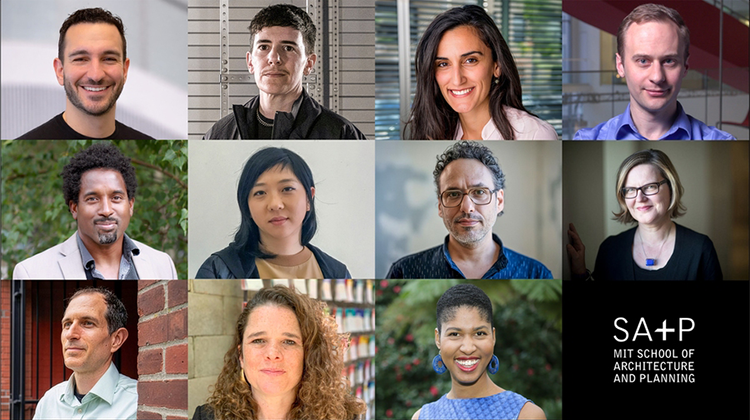
Top row, left to right: Fadel Adib, Xavi Aguirre, Canan Dağdeviren, and Kevin Esvelt. Middle row, left to right: Jason Jackson, Rosalyne Shieh, Nida Sinnokrot, and Kristel Smentek. Bottom row, left to right: Justin Steil, Sarah Williams, and Danielle Wood. Credit: Courtesy of the School of Architecture and Planning
Faculty Promotions in the Department of Urban Studies and Planning
Effective July 1, 2026, the MIT School of Architecture and Planning recognized three faculty members in the Department of Urban Studies and Planning with promotions for their significant contributions to the school.
“These individuals offer the MIT community creativity, knowledge, and scholarship that is exhilarating,” says Hashim Sarkis, dean of the School of Architecture and Planning. “Collectively, they add considerable strength to our faculty and research capacity.”
Jason Jackson has been promoted to associate professor with tenure. Jackson is an associate professor of political economy and director of the Political Economy Lab. His research focuses on the relationship between states and markets, particularly the role of economic ideas and moral beliefs in shaping market institutions under modern capitalism. Empirically, his work focuses on contexts ranging from the role of economic nationalism in industrial development to the rise of the digital “platform” economy and urban mobility markets in contemporary cities in Africa, Asia, and the Americas. Jackson is the author of “Traders, Speculators and Captains of Industry: How Capitalist Legitimacy Shaped Foreign Investment Policy in India” (Harvard University Press, 2025) and “Constructing Economic Nationalisms in Brazil and India” (Cambridge University Press, 2026).
Justin Steil has been promoted to full professor. Steil is professor of law and urban planning and a Margaret MacVicar Faculty Fellow. As Academic Curriculum Committee faculty chair, he leads a new faculty committee for the MIT Center for Real Estate and the Master of Science in Real Estate Development program, bringing together faculty from across the school to shape the future of the curriculum. As a lawyer, a paramedic, and an urban planner, Steil’s research focuses on spatial dimensions of inequality. Steil analyzes spatial inequality in the domains of environmental justice, housing and land use policies, and health equity, among others. Recent research focuses on the effects of neighborhoods on health, on mobility risk, and on the role of emergency medical services in advancing health equity.
Sarah Williams has been promoted to full professor. Williams, the Norman B. (1938) and Muriel Leventhal professor of architecture and planning, is the director of the Civic Data Design Lab and director of the Norman B. Leventhal Center for Advanced Urbanism. Williams combines her training in computation and design to create communication strategies that expose urban policy issues to broad audiences and create civic change, a process she calls Data Action. Williams is co-founder and developer of Envelope.city, a web-based software product that visualizes and allows users to modify zoning in New York City. In her book “Data Action: Using Data for Public Good” (The MIT Press, 2022), Williams provides a guide for working with data in more ethical and responsible ways.
Learn more about all faculty promotions across MIT SA+P during 2026: https://news.mit.edu/2026/faculty-receive-promotions-school-architecture-and-planning-0903