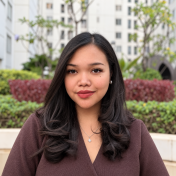







Amanda Dian Widyasti Kusumawardani
Amanda Kusumawardani is a Master in City Planning student at the MIT Department of Urban Studies and Planning. Her interests lie at the intersection of urban mobility, human behavior, urban transformation, and climate resilience, with a particular interest in how data, emerging technologies, and artificial intelligence can be used to better understand cities and inform planning decisions.
Before coming to MIT, Amanda worked at Indonesia’s Ministry of Public Works, where she contributed to some of the country’s largest national urban initiatives. She was involved in the National Urban Development Project and the preparation of the National Urban Transformation Program, both developed in collaboration with the World Bank. She worked across national and local governments and with international development partners on integrated city planning, infrastructure investment, and the translation of long-term urban policy goals into implementable programs.
Most recently, Amanda worked with the World Resources Institute (WRI) on urban climate resilience, contributing to the development of a coastal city resilience framework and research on urban heat reduction strategies. Her work focused on translating climate resilience goals into planning frameworks and measurable indicators for Indonesian cities.
At MIT, Amanda works as a research assistant with Professor Brent Ryan on projects examining urban transformation across different geographic and historical contexts. Her work includes studying the morphological and redevelopment impacts of urban highway removal in Providence, New Haven, and Rochester; housing market change amid vacancy, disinvestment, and uneven redevelopment in Youngstown, Ohio; and the long-term adaptation and evolution of urban grid systems in British Caribbean cities. These projects combine spatial, historical, and quantitative approaches to understand how urban form and neighborhoods respond to infrastructure, economic change, and planning interventions.
Amanda also conducts research with Professor Fabio Duarte at the MIT Senseable City Lab, where she uses computer vision and artificial intelligence to study human activity, mobility behavior, microclimate, and the social use of urban public spaces. This work reflects her broader interest in using emerging computational methods to understand how people experience and interact with urban environments.
Her work has received international recognition, including the ISOCARP Student Award (Special Mention), and she was awarded the MIT Racially Just Research Initiative Microgrant to support research on transport equity and the distributional impacts of public transit integration in Jakarta.
Amanda holds a Master’s degree in Economic Planning and Development Policy from the University of Indonesia, where her research focused on the effects of road-rationing policy on housing prices, and a Bachelor’s degree in Urban and Regional Planning from Institut Teknologi Bandung.